
Best Sale


Breville BOV900BSS Smart Oven Air Fryer Pro and Convection Oven, Brushed Stainless Steel
- Regular price
- $1,199.85
- Sale price
- $1,199.85


LO4011 - Rhodium Brass Ring with No Stone
- Regular price
- $2.31
- Sale price
- $2.31


TK2942 - High polished (no plating) Stainless Steel Ring with No Stone
- Regular price
- $4.62
- Sale price
- $4.62


Sport Neckband Bluetooth Earphone Magnetic Wireless Headphones
- Regular price
- $16.89
- Sale price
- $16.89


Bluetooth i7s TWS Wireless earbuds for Iphone Huawei Samsung
- Regular price
- $16.38
- Sale price
- $16.38


Frida Baby Thermometer, 3-in-1 Infrared Thermometer for Ear, Forehead & Touchless, Fever Thermometer for Baby, Infants, Toddlers, Kids & Adults
- Regular price
- $95.97
- Sale price
- $95.97



Product sidebar
Categories
Best Sale
Breville BOV900BSS Smart Oven Air Fryer Pro and Convection Oven, Brushed Stainless Steel
- Regular price
- $1,199.85
- Sale price
- $1,199.85
LO4011 - Rhodium Brass Ring with No Stone
- Regular price
- $2.31
- Sale price
- $2.31
TK2942 - High polished (no plating) Stainless Steel Ring with No Stone
- Regular price
- $4.62
- Sale price
- $4.62
Sport Neckband Bluetooth Earphone Magnetic Wireless Headphones
- Regular price
- $16.89
- Sale price
- $16.89
Bluetooth i7s TWS Wireless earbuds for Iphone Huawei Samsung
- Regular price
- $16.38
- Sale price
- $16.38
Frida Baby Thermometer, 3-in-1 Infrared Thermometer for Ear, Forehead & Touchless, Fever Thermometer for Baby, Infants, Toddlers, Kids & Adults
- Regular price
- $95.97
- Sale price
- $95.97

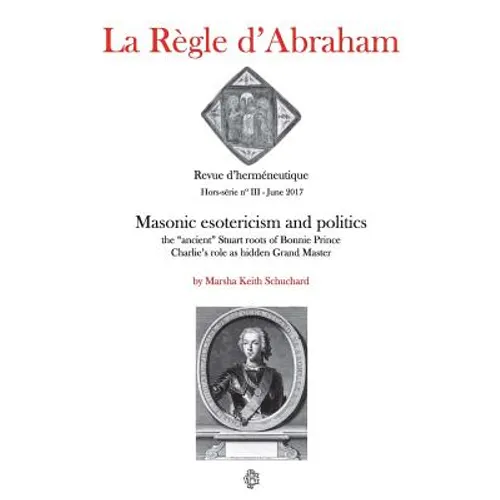
La Règle d'Abraham Hors-série #3 (B&W): Masonic esotericism and politics: the "ancient" Stuart roots of Bonnie Prince Charlie's role as hidden Grand M - Paperback
- Regular price
- $18.90
- Sale price
- $18.90
Couldn't load pickup availability
Details
- SKU: 9781976208362
- Availability: In Stock
Description
by Marsha Keith Schuchard (Author)
Mainly focused on the study of esoteric traditions within the three monotheist Revelations, La Règle d'Abraham is a periodical founded and directed by Patrick Geay since April 1996. This special edition in English, with 20 rare Masonic illustrations, is dedicated to an important article by Marsha Keith Schuchard on Masonic esotericism and politics: the "ancient" Stuart roots of Bonnie Prince Charlie's role as hidden Grand Master
Research into Charles Edward Stuart's alleged affiliation with Jacobite or Ecossais Freemasonry has long been hampered by the misleading assumption, which became academic "conventional wisdom," that Freemasonry virtually began in England when the Grand Lodge of London was formed in 1717. Moreover, it was generally characterized as non-political and rationalistic, devoted to the Protestant succession, the Hanoverian government, Newtonian science, and latitudinarian religion. However, the recent international expansion of Masonic and Jacobite studies makes possible a more credible and documented study of the Stuart prince's political and Masonic activities, within a context of anti-Hanoverian, politically-active, diplomatically-diverse, and spiritually-oriented Masonry that draws upon the early Scots-Irish traditions maintained by the Stuart kings in Greater Britain and by the exiles in the Jacobite diaspora. Ranging from the 1590s in Scotland to the 1780s in Italy, the Stuart-Masonic themes of Jewish mysticism, Lullist illuminated knighthood, Solomonic architecture, and religious toleration sustained the military and political campaigns of James II, James III, and "Bonnie Prince Charlie" in their struggle to reclaim the thrones of their ancestors. Table of contents IntroductionSwift, Lull, and the masonic Art of Memory
Stuart freemasonry and solomonic architecture
Jacobite versus Hanoverian rivalries
Mar, Ramsay, and the restoration of Stuart freemasonry
"Bonnie Prince Charlie" emerges on the masonic stage
The Royal Order of Heredom and Kilwinning
The ancient chivalry of the Temple of Jerusalem
The fates of the Jacobite Grand Masters
The hidden Grand Master and the Écossais network
Old world royalists and new world revolutionaries
Restoring the Temple in the North
Conclusion Fondée en 1996 La Règle d'Abraham est une revue annuelle française d'herméneutique principalement consacrée à l'étude des traditions ésotériques issues des trois révélations monothéistes: judaïsme, christianisme, islam. Pour autant, elle est aussi vouée à la connaissance approfondie de toutes les religions du monde. Son but est de favoriser une meilleure compréhension de celles-ci, mais également d'établir l'existence d'un véritable fond commun universel à partir de leur dimension intérieure, métaphysique, cosmologique et symbolique. Notre revue vise en ce sens le rétablissement d'une interprétation spirituelle du sacré en général, en opposition à toutes les formes de réductionnisme qu'elle critique. Elle fait appel à des spécialistes, universitaires le plus souvent ou indépendants. Nous publions des recherches originales inédites ainsi que des traductions de textes anciens et contemporains. Certains articles parus dans La Règle d'Abraham ont eux-mêmes été traduits et publiés en Espagne, en Italie et aux Etats-Unis.
Author Biography
After studying in Vienna, Austria, and Kampala, Uganda, Marsha Keith Schuchard received a Ph.D. from the University of Texas at Austin for her thesis, "Freemasonry Secret Societies and the Continuity of the Occult Traditions in British Literature." While working as a medical editor in the international field of drug abuse prevention, she visited libraries and archives in many countries, where she continued her independent investigations of what she characterizes as "suppressed history." She is especially interested in 18th- and 19th-century secret societies, Jacobitism, Jewish mysticism, Sabbatianism, Swedenborgianism, Moravianism, and other heterodox religions, focusing on their influence on politics, literature, and the arts. Besides over sixty scholarly articles, she has published three books, Restoring the Temple of Vision: Cabalistic Freemasonry and Stuart Culture (Brill, 2002); Why Mrs. Blake Cried: William Blake and the Sexual Basis of Spiritual Vision (Random House, 2006); Emanuel Swedenborg, Secret Agent on Earth and in Heaven: Jacobites, Jews, and Freemasons in Early Modern Sweden (Brill, 2012); and has completed a new one, Masonic Rivalries and Literary Politics: From Jonathan Swift to Henry Fielding (forthcoming).
Number of Pages: 116
Dimensions: 0.24 x 9.21 x 6.14 IN
Illustrated: Yes
Publication Date: September 07, 2017
Share